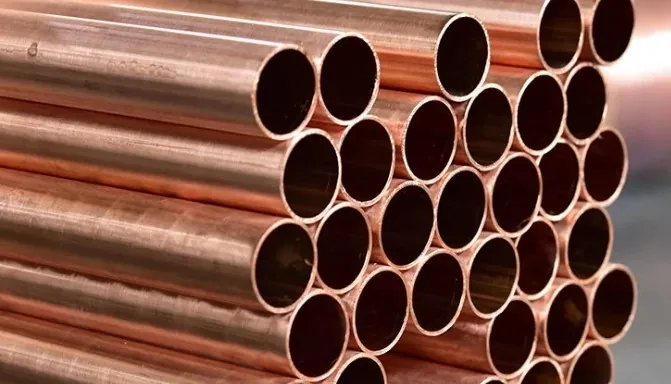
Copper tubes are the quiet backbone of modern buildings, refrigeration plants, heat exchangers and process industries. Choosing the right supplier means understanding what separates a reliable copper tubes manufacturer in India from a trader: control over the melt, the extrusion and drawing route, the annealing atmosphere and the final testing. This guide explains how seamless copper tubes are made, which grades and standards apply, and what a buyer should ask for before placing an order.
A seamless copper tube is a hollow, round product with no longitudinal weld. It is produced by extruding or piercing a solid copper billet into a thick-walled shell and then reducing it by cold drawing to the final outside diameter (OD) and wall thickness. Because there is no weld seam, seamless copper tube has uniform grain structure, predictable pressure performance and excellent bendability, which is why it is specified for potable water, medical gas, fuel gas, refrigerant and heat-transfer duties.
Copper is also naturally antimicrobial, 100% recyclable and offers excellent thermal conductivity (around 385 W/m·K), so a copper tube transfers heat far more efficiently than steel or plastic of the same size.
Quality starts with the charge. Premium copper tubes are made from LME Grade A copper cathode (99.99% Cu minimum), sometimes blended with clean, traceable scrap of known analysis. The chemistry decides the grade:
Every heat is checked on an optical emission spectrometer before casting, so the chemistry on the mill test certificate matches the metal that actually goes into the furnace.
Specifications govern chemistry, dimensions, tolerances, test pressure and marking. The most common are summarised below.
| Standard | Scope | Typical alloy | Typical use |
|---|---|---|---|
| ASTM B88 | Seamless copper water tube, Types K, L, M | C12200 | Plumbing, fire sprinkler, medical and fuel gas |
| ASTM B280 | Seamless copper tube for ACR field service | C12200 | Air conditioning and refrigeration |
| ASTM B75 | Seamless copper tube, general purpose | C10200, C12000, C12200 | Industrial, heat exchangers |
| EN 1057 | Round tube for water, gas and heating (R220, R250, R290) | CW024A (Cu-DHP) | European plumbing and heating |
| EN 12449 | Seamless round tube for general purposes | Cu-DHP and other listed grades | Engineering and process |
| IS 2501 | Copper tubes for general engineering | Cu-DHP | Indian engineering and utilities |
Under ASTM B88 the nominal size is not the actual OD: a 1/2 in nominal tube has an outside diameter of 5/8 in. ACR tube to ASTM B280 is sized by actual OD in 1/8 in steps. Always state which convention your drawing uses.
A credible mill verifies each lot against the standard. Typical checks include:
Insist on an EN 10204 3.1 mill test certificate and, for critical projects, independent third-party inspection before shipment.
To receive an accurate quotation, give your supplier: grade (C12200, C11000 or C10200), applicable standard, OD and wall thickness (or nominal size and Type), temper (soft O60 or hard H58), supply form (straight lengths, plain coils, pancake coils or level wound coils), quantity, test and certification requirements, and packing and destination. This removes ambiguity and speeds up lead time.
Melta Alloys manufactures and exports copper tubes and pipes from Umbergaon, Gujarat, supplying customers in 20+ countries. Our integrated route of casting, extrusion, precision tube drawing and in-house testing, with spectrometer analysis, hardness testing and hydrostatic testing up to 500 bar, lets us supply OD from 6 mm to 600 mm and lengths up to 12 m, with full material traceability and mill test certificates on every shipment. Explore the full copper pipes and tubes range or send us your specification for a quote.
C12200 (Cu-DHP) is the most widely used grade for plumbing, HVAC and heat-exchanger tubes because it is easy to braze, weld and bend. C11000 ETP suits electrical duties, and C10200 oxygen-free copper is chosen for vacuum and electronic applications.
ASTM B88 covers seamless copper water tube (Types K, L and M) for plumbing and gas systems. ASTM B280 covers seamless copper tube for air conditioning and refrigeration field service and adds strict cleanliness requirements for the bore.
Yes. Soft (O60) tube is supplied in plain, pancake or level wound coils, while hard drawn (H58) tube is supplied straight in lengths up to 12 m, cut to your requirement.
Every shipment is supplied with a mill test certificate showing chemical composition and mechanical properties, and third-party inspection can be arranged on request.
Send your grade, size, standard and quantity — our team replies with pricing, lead time and mill test certificate details.