Melta Alloys logo - copper tubes and brass tubes manufacturer MELTA ALLOYS
Copper · Brass · Bronze

Copper Level Wound Coils (LWC) Manufacturer: Long-Length Copper Tube for Automated HVAC Production

Copper level wound coils (LWC) manufacturer in India: long-length annealed copper tube on spools for AC coil and heat-exchanger lines. Process, sizes, ASTM B280/B68, QC.

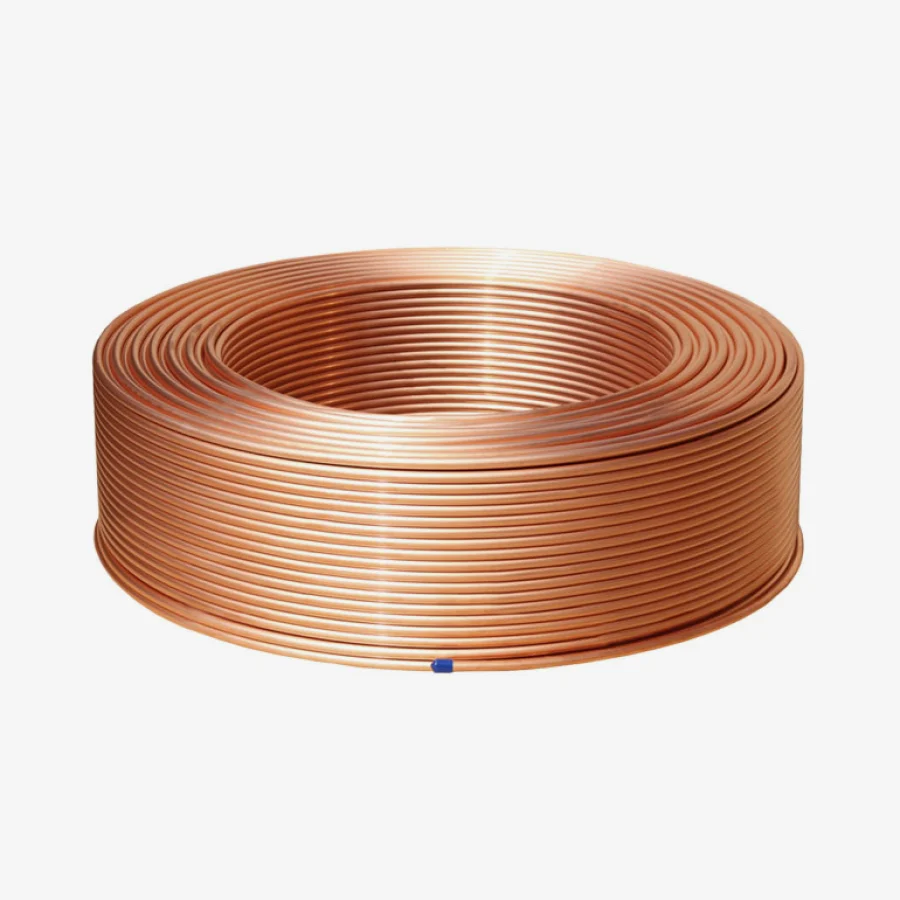
Copper level wound coils LWC manufacturer in India - long length copper tubes on spools for AC coil production
Copper Level Wound Coils — manufactured and exported by Melta Alloys, Umbergaon, Gujarat.

Behind every air-conditioner evaporator and condenser coil is a long, uniform copper tube that has been straightened, cut and bent into hairpins at high speed. For these automated lines, loose loops of tube or small pancake coils are inefficient. Manufacturers instead buy copper level wound coils (LWC), also called layer wound coils: very long, continuous lengths wound in neat parallel layers on a spool. This guide explains the product, how a copper level wound coils manufacturer produces it and what to verify before placing an order.

What Is a Level Wound Coil?

A level wound coil is soft annealed seamless copper tube wound onto a flanged spool or drum with a traversing guide, so each turn lies tightly beside the previous one and each layer sits level over the layer below. The result is a heavy, stable package that holds hundreds of metres, often several hundred kilograms of tube, without crossovers or tangles. The tube pays off smoothly into straighteners, hairpin benders and cutting machines at line speed.

Why HVAC Manufacturers Prefer LWC

  • Fewer reel changes: very long lengths mean the line stops less often.
  • Less scrap: continuous lengths reduce end-offcut waste compared with many short coils.
  • Fewer joints: where tube is used in long serpentine circuits, a single length avoids brazed joints.
  • Consistent payoff: layer winding prevents loops pulling tight and kinking the tube.
  • Compact logistics: one spool replaces many small coils, saving packing and handling labour.

Typical Specifications

ParameterTypical value
AlloyC12200 Cu-DHP (C10200 on request)
TemperO60 soft annealed
StandardsASTM B280, ASTM B68, EN 12735-2 and customer specifications
OD rangeCommonly 5 mm to 15.88 mm (for example 5, 7, 7.94, 9.52, 12.7 mm)
Wall thicknessPer OEM drawing (typically 0.2 mm to 0.8 mm class for heat-exchanger duty)
Supply formSpool, drum or reel with specified flange size and arbor
CleanlinessLow residual oil, dry bore, ends sealed

Tubes for OEM coil lines are specified against a drawing, so tolerances on OD, wall and ovality are usually tighter than general plumbing tube. Share your drawing and spool dimensions and we will confirm feasibility.

How Level Wound Coils Are Made

  1. Seamless tube drawing: extruded shells are drawn through successive dies, with in-line annealing between passes, until the OD and wall meet the drawing.
  2. Precision finishing draw: the last pass fixes dimensional accuracy and surface finish; any residual lubricant is then removed.
  3. Level winding: the finished tube is wound under controlled tension onto the spool, with a traverse speed matched to tube OD so the layers lie flat.
  4. Bright annealing: spools are annealed in a protective atmosphere (nitrogen or hydrogen-nitrogen) so the tube is soft, clean and bright; temperature and soak time are controlled to deliver a uniform grain size and hardness along the entire length.
  5. Internal cleaning and drying: the bore is flushed and dried; nitrogen charging and sealing keep it clean in transit.
  6. Testing: OD, wall, ovality, hardness, grain size, flaring and flattening checks, and non-destructive or pressure testing as per the standard.
  7. Packing: spools are strapped to pallets or placed in wooden crates with protective wrap.

Key Quality Parameters for LWC Tube

  • Uniform temper: inconsistent hardness along a long length causes springback variations in the hairpin bender.
  • Dimensional stability: ovality and wall eccentricity affect expansion and brazing quality inside fin-and-tube coils.
  • Surface cleanliness: drawing lubricants and oxides can contaminate refrigerant circuits and fouling brazed joints.
  • Winding quality: even layers and correct tension prevent damage at the spool flanges and during decoiling.
  • Grain size: a fine, even grain avoids "orange peel" at tight bends and expansion in fin collaring.

Applications

  • Hairpin tube for room air conditioners, ducted units and chillers
  • Evaporator and condenser coils for refrigeration and heat pumps
  • Radiators, oil coolers and automotive heat exchangers (where compatible)
  • Water-to-refrigerant brazed or coil-in-shell exchangers
  • Cooling coils for industrial equipment

LWC vs Pancake vs Plain Coil

Level wound coils shine on automated lines; pancake coils are best for hand installation, and plain coils suit short plumbing runs. For a full comparison of all formats, see our copper coils overview.

Working with Melta Alloys on LWC Requirements

Melta Alloys manufactures copper tube from billet to finished coil at Umbergaon, Gujarat, and exports to 20+ countries. For OEM and coil-line customers we agree drawings, OD and wall tolerances, spool dimensions, temper and cleanliness in advance, then supply each lot with a mill test certificate. Browse the copper tubes range or send your drawing for a feasibility check and quotation.

Frequently Asked Questions

What is LWC in copper tubes?

LWC stands for level wound coil, a long length of annealed copper tube wound in parallel layers on a spool. It is used mainly by air-conditioner and heat-exchanger manufacturers on automated lines.

How long is a level wound copper coil?

Lengths vary with OD and spool size, and can reach several hundred metres per spool. Share your decoiler capacity and we will propose a suitable length and weight.

Are level wound coils soft or hard?

They are soft annealed (O60) so the tube can be straightened, cut and bent into hairpins without cracking or wrinkling.

Can you supply level wound coils to customer drawings?

Yes. We work from OEM drawings for OD, wall thickness, temper, cleanliness and packing, and confirm feasibility before quoting.

Need Copper Level Wound Coils?

Send your grade, size, standard and quantity — our team replies with pricing, lead time and mill test certificate details.

Related Technical Guides