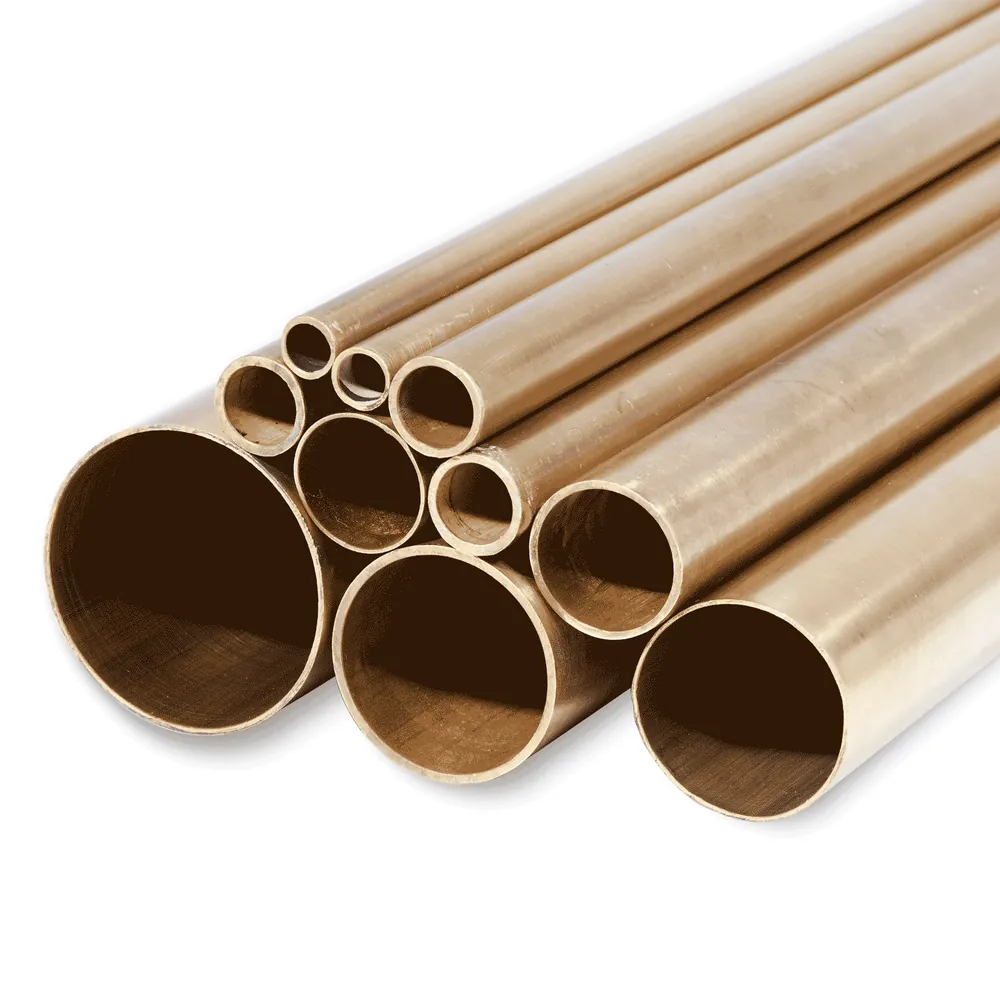
Heat exchangers move energy between fluids, and the tube wall is where the work happens. Brass has been a go-to tube material for cooling-water duty for more than a century because it combines good thermal conductivity, workability and resistance to many waters at a moderate cost. This guide from a brass heat exchanger tubes manufacturer in India compares the principal alloys, standards and test requirements so you can select the right tube for shell-and-tube exchangers, coolers and condensers.
| Alloy | UNS | Nominal composition | Typical service |
|---|---|---|---|
| Admiralty brass | C44300 / C44400 / C44500 | 71% Cu, 28% Zn, 1% Sn, inhibited with As, Sb or P | Fresh and brackish cooling water, power condensers, oil coolers |
| Naval brass | C46400 | 60% Cu, 39.25% Zn, 0.75% Sn | Marine heat exchangers, ballast and seawater cooling, tubesheets |
| Aluminium brass | C68700 | 77.5% Cu, 20.5% Zn, 2% Al, As-inhibited | Seawater and polluted water, desalination, marine condensers |
| Cartridge brass | C26000 | 70% Cu, 30% Zn | Radiators and light-duty exchangers |
The small additions of arsenic, antimony or phosphorus in Admiralty brass suppress dezincification, the selective loss of zinc that leaves a weak, porous copper structure. Aluminium brass forms a protective aluminium-rich film that improves resistance to impingement attack in higher velocity water.
Brass billets are cast, heated to roughly 650–750 °C and extruded into tube shells, then drawn to final OD and wall through dies on mandrels or floating plugs. Annealing between passes controls grain size and ductility, and a final stress-relief anneal reduces residual stress to protect against season cracking. Tubes are straightened, cut, cleaned and tested. For U-bend exchangers, tubes are bent after annealing and locally stress relieved if specified.
| Test | Purpose |
|---|---|
| Chemical analysis | Confirms alloy and inhibitor content |
| Dimensional check | OD, wall, straightness and length tolerances |
| Hydrostatic or eddy-current test | Detects leaks and discontinuities |
| Flattening and expansion test | Checks ductility for tubesheet rolling |
| Mercurous nitrate or ammonia vapour test | Confirms low residual stress (ASTM B154, B858) |
| Grain size and hardness | Verifies temper and anneal quality |
For condenser-specific sizing, wall gauges and failure modes, continue with our guide to brass condenser tubes.
Melta Alloys manufactures Admiralty, Naval and other brass tubes in Umbergaon, Gujarat, using extrusion presses and precision tube mills, in-house spectroscopy and hydrostatic testing up to 500 bar. Each shipment carries a mill test certificate and we export to 20+ countries. See the brass pipes and tubes range or send your drawing for a quotation.
Admiralty brass (C44300) is the standard choice for fresh and brackish cooling water, while aluminium brass (C68700) and Naval brass (C46400) are preferred for seawater and marine duty.
ASTM B111 (ASME SB-111) and EN 12451 are the main specifications; ASTM B359 covers finned tubes.
A small arsenic, antimony or phosphorus addition inhibits dezincification, the selective leaching of zinc that weakens brass in water.
Yes. Tubes can be supplied straight, cut to length or as per drawing; share your tube list and tolerances for a quotation.
Send your grade, size, standard and quantity — our team replies with pricing, lead time and mill test certificate details.