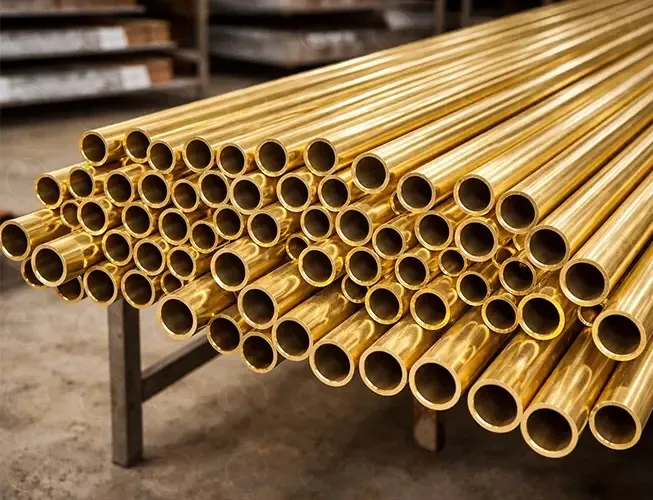
Surface condensers convert exhaust steam back to water in power stations, refineries, process plants and ships, and thousands of thin tubes do the work. A single leaking tube can contaminate boiler feed water, so tube quality is not a place to cut corners. This guide from a brass condenser tubes manufacturer in India covers the sizes, gauges, specifications, testing and care that determine condenser tube life.
Brass condenser tubes are seamless, thin-walled tubes made from inhibited brass alloys, used in shell-and-tube surface condensers where cooling water flows inside the tubes and steam condenses outside. The most common alloys are:
Condenser tubes are standardised by outside diameter and Birmingham Wire Gauge (BWG) wall thickness. Common combinations:
| OD (in / mm) | Typical BWG | Wall (mm) |
|---|---|---|
| 5/8 in / 15.88 | 20, 18 | 0.89, 1.24 |
| 3/4 in / 19.05 | 20, 18, 16 | 0.89, 1.24, 1.65 |
| 1 in / 25.4 | 18, 16, 14 | 1.24, 1.65, 2.11 |
| 1-1/4 in / 31.75 | 16, 14 | 1.65, 2.11 |
Lengths range from short exchanger tubes to long condenser tubes of 10 m or more, cut to tubesheet spacing with allowance for expansion. Custom OD and wall can be produced for retubing projects to match existing drawings.
Brass condenser tubes are produced by hot extrusion of cast billet, cold drawing in several passes and intermediate anneals. A controlled final anneal gives a uniform, fine grain for expanding into tubesheets. Because cold-drawn brass retains residual stress that can cause season cracking, tubes are given a stress-relief anneal, and residual stress is verified by ammonia vapour or mercurous nitrate testing where specified. Straightening, cleaning and end finishing complete the process.
| Failure | Cause | Prevention |
|---|---|---|
| Impingement / inlet-end erosion | High velocity, air bubbles, sand | Ferrules, flow limits, clean water, correct alloy |
| Dezincification | Hot, stagnant or aggressive water | Inhibited brass, good water chemistry |
| Ammonia stress corrosion | Ammonia in steam air-removal zone | Different alloy for air-cooler section |
| Pitting and deposit attack | Fouling, under-deposit corrosion | Regular cleaning, chlorination control |
| Vibration fatigue | Unsupported span | Correct support spacing |
Admiralty brass is economical for clean cooling water, aluminium brass handles seawater at higher velocity, copper-nickel and titanium take over in aggressive or high-chloride service at higher cost. Choose by lifecycle cost, not purchase price alone. For a wider look at exchanger alloys, read about brass heat exchanger tubes.
Melta Alloys makes Admiralty and other brass condenser tubes at Umbergaon, Gujarat, with precision tube mills, spectrometer analysis and hydrostatic testing up to 500 bar. We supply power utilities, shipyards, OEMs and stockists in 20+ countries with full material traceability and mill test certificates. Explore the brass condenser and heat exchanger tubes range or share your tube schedule for a quote.
Admiralty brass (C44300) is most common for fresh and brackish cooling water. Aluminium brass (C68700) is preferred for seawater and higher flow velocities.
Typical ODs are 5/8, 3/4, 1 and 1-1/4 inch (15.88, 19.05, 25.4 and 31.75 mm) in walls from about 0.89 mm (20 BWG) to 2.11 mm (14 BWG). Custom sizes can be made for retubing.
Cold-drawn brass is stress-relief annealed after drawing, and residual stress is verified with ammonia vapour or mercurous nitrate tests where required.
Yes. Each lot ships with a mill test certificate, and third-party inspection can be arranged.
Send your grade, size, standard and quantity — our team replies with pricing, lead time and mill test certificate details.