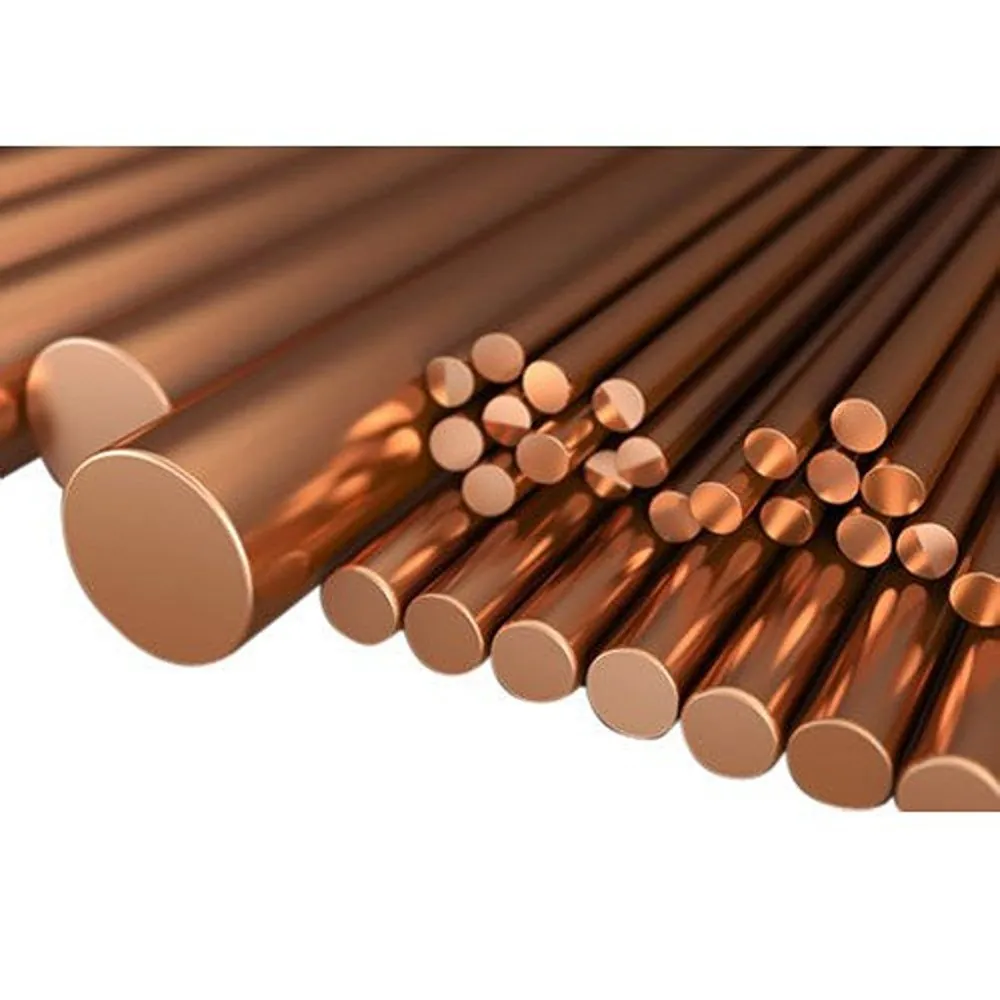
Copper round bars, also sold as copper rods, appear in electrical contacts, earthing electrodes, welding tips, bearing and heat-sink components, forged parts and countless machined products. Because copper is soft and gummy to machine and highly sensitive to purity, choosing the right grade and finish is essential. This guide from a copper round bars manufacturer in India covers grades, standards, sizes, tolerances and machining practice.
A copper round bar is a solid, circular-section product in straight lengths, made by extrusion or by cold drawing from extruded or continuously cast stock. Diameters range from a few millimetres to well over 100 mm. Bars may be supplied as extruded (hot-finished), cold-drawn and straightened, or peeled and turned for a bright, accurate surface.
| Grade | UNS | Cu content | Special features |
|---|---|---|---|
| Cu-ETP | C11000 | 99.90% min | Highest practical conductivity; most electrical bar |
| Cu-OF (OFHC) | C10200 | 99.95% min | Very low oxygen; vacuum, electronics, brazing in H2 atmospheres |
| Cu-DHP | C12200 | 99.90% min | Phosphorus deoxidised; weldable and brazeable |
| Cu-FRHC | IS grade | 99.90% min | Fire-refined high conductivity, Indian practice |
If heavy machining is the priority rather than conductivity, specialty free-machining coppers such as tellurium copper (C14500) are used; they trade a little conductivity for much better chip breaking. Ask your supplier if this applies to your part.
Round bars are normally available in diameters from about 6 mm to 150 mm, with straight lengths of 3 m to 6 m and up to 12 m on request. Typical diametral tolerance classes include h9 and h11 for drawn bars and wider grades for extruded bars; roundness and straightness are also specified (for example, a maximum bow in mm per metre). For automatic lathes, request peeled or ground bar to tight tolerances; for forging or hot-working, as-extruded bar is usually sufficient.
Copper work-hardens and tends to produce long, stringy chips and built-up edge. Best practice:
Copper gives conductivity, but brass bars machine far faster and cost less per part. If conductivity above 85% IACS is not required, see our guide to brass round bars. For flat conductors, see copper flat bars.
Melta Alloys produces copper round bars from our extrusion and drawing lines in Umbergaon, Gujarat, with spectrometer, hardness and mechanical testing and full material traceability. We export to 20+ countries with a mill test certificate on every shipment. Explore our copper round bars range or send your diameter list and grade requirement.
In practice the terms overlap. "Rod" often refers to smaller diameters or coiled products, while "bar" refers to straight, larger sections. Both are solid round products made to the same grades and standards.
Use C11000 for general electrical parts, C10200 where purity or hydrogen-atmosphere brazing is needed, and C12200 where welding or brazing is part of the fabrication process.
We supply a wide diameter range with custom sizes to order. Share your diameter, length, tolerance and quantity for confirmation.
Yes. Each shipment includes a mill test certificate with chemical composition and mechanical properties, and third-party inspection can be arranged.
Send your grade, size, standard and quantity — our team replies with pricing, lead time and mill test certificate details.