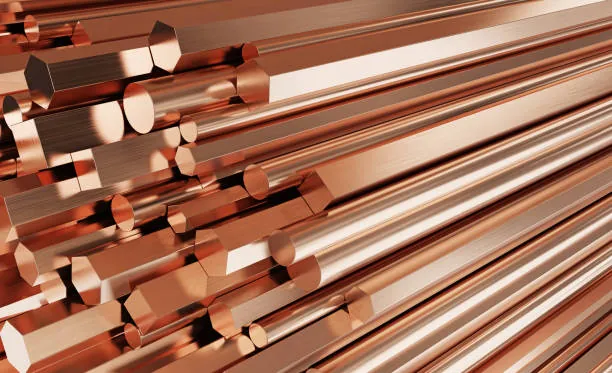
Open any low-voltage switchboard, motor control centre, UPS cabinet or substation and the main power is carried by copper busbars: rigid conductors that distribute current between incoming supplies and outgoing feeders. A busbar failure is rarely cheap, so specifying the right grade, size, finish and joint design pays for itself. This guide from a copper busbars manufacturer in India covers the engineering fundamentals buyers and panel builders need.
A busbar is a bar, strip or tube of high-conductivity metal that collects and distributes electrical power. Copper busbars are normally rectangular in section, produced from Cu-ETP (C11000) to ASTM B187 or EN 13601, and supplied with square, chamfered or fully rounded edges. Compared with aluminium, copper has about 60% higher conductivity, so a copper bar can be smaller, runs cooler for a given current and has better joint reliability.
Aluminium is lighter and cheaper per kilogram, so large utility bars are sometimes aluminium, but copper remains the first choice for compact, high-reliability switchgear.
Busbar selection is a thermal and mechanical design problem. The main inputs are:
As a rough rule of thumb, copper busbars in enclosed panels are often designed for a current density somewhere between 1.0 and 1.6 A/mm², depending on size, ventilation and standard. Always confirm with ampacity tables (for example the DIN 43671 series or manufacturer data) and verification to IEC 61439.
| Section (width × thickness, mm) | Area (mm²) | Common use |
|---|---|---|
| 20 × 3 | 60 | Small MCC outgoing feeders, earthing |
| 30 × 5 | 150 | Distribution boards |
| 50 × 6 | 300 | Main distribution panels |
| 80 × 10 | 800 | Main switchboards |
| 100 × 10 | 1000 | Large LV incomers, UPS |
| 100 × 12 | 1200 | High-capacity incomers |
Custom sizes and multiple bars per phase are common for higher currents.
Most busbar failures start at joints. Use flat, clean overlapping surfaces, a bolt pattern and torque specified for the bar width, Belleville (disc) washers to maintain contact pressure through thermal cycling, and an antioxidant joint compound on bare copper. Avoid mixing copper and aluminium without bimetallic washers or plated transition pieces.
Cu-ETP is cast into billets or slabs, hot extruded or rolled to near size, cold drawn or rolled to final dimensions with rounded edges, annealed or tempered as needed, straightened and cut. Optional steps include punching, bending, drilling, plating and insulation. See ETP grade flat bars for metallurgy and copper flat bars for dimensional data.
Melta Alloys manufactures copper bus bar stock in C11000 and C10200 at Umbergaon, Gujarat, supplying panel builders, EPC contractors and distributors in 20+ countries. Each lot is verified by spectrometer and hardness testing, with a mill test certificate and export-grade packing. View our copper flat bars and busbar range or send the sizes and quantities you need.
Cu-ETP (C11000), with at least 99.90% copper and conductivity of 100% IACS or better, is the standard busbar grade. Oxygen-free C10200 is used for special applications.
Rating depends on cross-section, orientation, number of bars per phase, temperature rise and enclosure ventilation. Use standard ampacity tables or the IEC 61439 verification methods; a typical design current density is about 1.0–1.6 A/mm² for enclosed copper bars.
Rounded edges reduce electric-field concentration, improve the fit of insulation, and make handling safer. Specify the edge radius when ordering.
Plating can be arranged on request. Mention the thickness and standard in your enquiry and we will confirm the feasibility.
Send your grade, size, standard and quantity — our team replies with pricing, lead time and mill test certificate details.