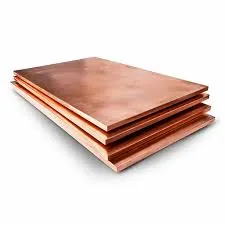
From transformer shielding and electrical terminals to heat shields, chemical equipment and architectural roofing, flat-rolled copper solves problems that no other metal solves as elegantly. This guide from a copper plates and sheets manufacturer in India explains how plates and sheets differ, which grades and tempers to specify, how rolled copper is made, and where each product is used.
The terms are defined by thickness and width in the standards. As a rule of thumb, thicker flat products are plates (commonly 6 mm and above, with ASTM tables for exact limits), thinner flat-rolled products are sheets, long and narrow coiled products are strips, and very thin material is foil. Copper plates and sheets are supplied flat in cut lengths, while strip is supplied in coils. Our range covers heavy plates (typically 3 mm to 50 mm) and precision-rolled sheets (thinner gauges), and custom thicknesses are available.
| Grade | UNS | Features | Typical applications |
|---|---|---|---|
| Cu-ETP | C11000 | High conductivity (100% IACS), the standard electrical grade | Busbars, terminals, earthing plates, shielding |
| Cu-OF | C10200 | Oxygen-free, very low oxygen | Vacuum and electronic components, brazed assemblies |
| Cu-DHP | C12200 | Phosphorus-deoxidised, weldable | Heat exchangers, tube sheets, chemical equipment, roofing |
| Cu-DLP | C12000 | Lower phosphorus deoxidised | General fabricated parts |
Copper plates and sheets are supplied in:
Surface finish options include mill finish, pickled (bright), brushed and polished finish, with protective paper interleaving or film to prevent scratching. Specify surface requirements when the product is visible, such as architectural or decorative use.
Match thickness to the structural or current requirement, then select the temper for your forming process: soft temper for deep draws, quarter hard for bending and light forming, and half hard to hard for flat stampings and machined parts. State the tolerance class (normal or precision) and flatness requirement on your enquiry, especially for parts that will be laser cut or punched. For conductor strips and bars, see our copper flat bars guide.
Melta Alloys manufactures and exports rolled copper plates and sheets from Umbergaon, Gujarat, supported by sheet rolling mills, spectrometer and hardness testing, and full material traceability. Every shipment includes a mill test certificate, and we serve customers in 20+ countries. View the copper plates and sheets range or request a quote with your thickness, size, grade and quantity.
Heavy plates are typically available from 3 mm to 50 mm, with thinner precision-rolled sheets for stamping, roofing and electrical use. Custom thicknesses and sizes are available.
Cu-ETP (C11000) is the standard for electrical plates, while oxygen-free C10200 is chosen for vacuum and brazed assemblies and C12200 for plates that will be welded or brazed.
Temper describes hardness and strength resulting from rolling and annealing, for example soft (O60), quarter hard (H01), half hard (H02) and hard (H04). It determines formability and stiffness.
Yes. Plates and sheets can be supplied as standard sizes or cut to your dimensions, with protective interleaving for export packing.
Send your grade, size, standard and quantity — our team replies with pricing, lead time and mill test certificate details.