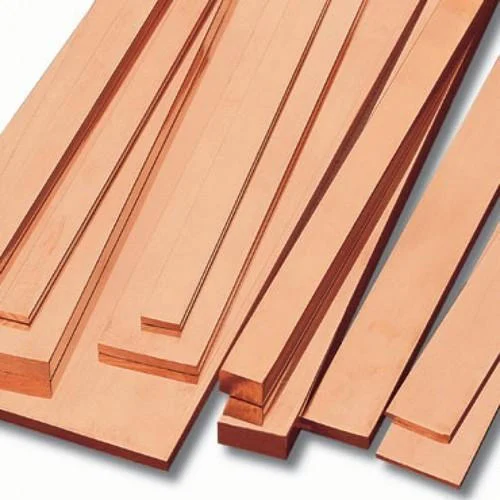
Copper flat bars are rectangular-section bars that carry large electrical currents, conduct heat away from critical parts and form the backbone of earthing and power distribution. Specifying them correctly means more than quoting width and thickness. This guide from a copper flat bars manufacturer in India explains the grades, standards, tempers and tolerances behind the product, and how bars are produced.
A copper flat bar is a solid, rectangular bar of copper with a width several times greater than its thickness, supplied in straight lengths. It may be produced by extrusion, hot or cold rolling, or drawing, and then straightened, cut to length and finished. Edges can be square, rounded or chamfered depending on the application; rounded edges are common for busbars because they lower local electric-field concentration and are safer to handle.
| Grade | UNS / EN | Typical conductivity | When to use |
|---|---|---|---|
| Cu-ETP | C11000 / CW004A | 100% IACS or higher (annealed) | Busbars, switchgear, earthing, general electrical |
| Cu-OF | C10200 / CW008A | About 101% IACS | Vacuum, high-purity and brazing in reducing atmospheres |
| Cu-DHP | C12200 / CW024A | About 85% IACS | Fabricated parts that will be welded or brazed |
For electrical use, C11000 (Cu-ETP) is the grade of choice: at least 99.90% copper including silver, with a small oxygen content that does not hurt conductivity. Our guide to ETP grade copper flat bars explains the metallurgy in detail.
Copper flat bars are normally available in three condition ranges:
Tensile strength rises and elongation falls as hardness increases, while conductivity is only slightly reduced, so most electrical busbars are supplied half hard or hard for stiffness yet still bend acceptably across the width.
Typical flat bars span thicknesses from about 2 mm to 50 mm and widths from about 10 mm to 200 mm or more, in lengths of 3 m to 6 m and up to 12 m on request. Tolerances for width, thickness, camber, twist and edge radius are given in the standard or agreed in the purchase order. Specify them on your enquiry. Typical examples: 25 × 3, 40 × 5, 50 × 6, 63 × 10, 100 × 10 and 100 × 12 mm, though custom sizes are made to order.
Request a mill test certificate (EN 10204 3.1) showing chemistry and mechanical properties, electrical conductivity where relevant, dimensional report and marking of grade and heat number. Bars should be free from cracks, laps, oxide scale and surface scratches that could concentrate current.
Melta Alloys produces rolled and extruded copper flat bars in C11000 and C10200 from Umbergaon, Gujarat, supplying panel builders, EPC contractors and distributors in 20+ countries. In-house spectroscopy and hardness testing, careful handling and export-grade packing mean your bars arrive ready for fabrication. See the full copper flat bars range or request a quote with your size list.
For electrical conductivity, Cu-ETP (C11000) is the standard grade. Oxygen-free C10200 is used where purity or brazing in a reducing atmosphere is required, and C12200 where welding is needed.
A busbar is a flat bar used to conduct electricity in a distribution system, normally with rounded edges and controlled dimensions. All busbars are flat bars, but not every flat bar is used as a busbar.
Surface treatments such as tin plating can be arranged for suitable orders. Please mention plating thickness and standard in your enquiry.
Standard lengths are 3 m to 6 m, and custom lengths up to 12 m can be produced depending on section size.
Send your grade, size, standard and quantity — our team replies with pricing, lead time and mill test certificate details.