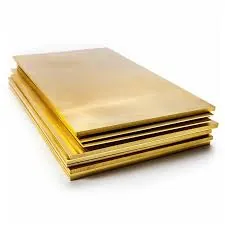
Brass plates and sheets show up in places most people never see: condenser tubesheets in power stations, deck fittings on ships, bearing housings, electrical terminals, stamped hardware and architectural cladding. The right alloy and temper make fabrication easy and service life long. This guide from a brass plates manufacturer in India explains the grades, standards, thickness ranges and rolling process.
By convention, thicker rolled product is called plate, thinner product sheet and long coils strip. Our range covers heavy brass plates in typical thicknesses of about 3 mm to 50 mm and rolled brass sheets in lighter gauges, with custom sizes and cut-to-size supply. Plates are normally hot rolled and then milled or pickled, while sheets and strip are finished by cold rolling to give accurate thickness and surface.
| Alloy | UNS | Composition | Highlights | Typical use |
|---|---|---|---|---|
| Cartridge brass | C26000 | 70% Cu, 30% Zn | Best cold formability, deep drawing | Stampings, electrical, radiator parts |
| Yellow brass | C27200 | 63% Cu, 37% Zn | Strong, lower cost | General fabrication |
| Muntz metal | C28000 | 60% Cu, 40% Zn | Hot workable, strong | Architectural and marine hardware |
| Naval brass | C46400 | 60% Cu, 39.25% Zn, 0.75% Sn | Seawater resistance | Condenser tubesheets, deck and hull fittings |
| Admiralty brass | C44300 | 71% Cu, 28% Zn, 1% Sn | Inhibited against dezincification | Tubesheets for condensers and exchangers |
Brass plates and sheets are supplied in the as-hot-rolled condition, in annealed tempers such as O60 and O61 for forming, and cold rolled tempers from quarter hard (H01) through half hard (H02) to hard (H04) and spring tempers. Annealed temper maximises ductility for deep drawing; hard tempers increase strength and stiffness for stamped flat parts. State the temper and, where relevant, the required Rockwell hardness range.
Brass plates can be sawn, sheared, laser cut, waterjet cut, machined, formed, drilled and brazed. For laser cutting, specify low-residual-stress flat plates; for marine tubesheets, specify the heat-treatment condition and ultrasonic or visual inspection where required. Naval and Admiralty brass plates should be stress relieved after heavy forming or welding to avoid season cracking.
For tubes that fit into these tubesheets see brass heat exchanger tubes. For copper equivalents, see copper plates and sheets.
Melta Alloys manufactures and exports brass plates, sheets and Naval and Admiralty brass plates from Umbergaon, Gujarat, backed by sheet rolling mills, spectrometer and hardness testing and full material traceability. We serve customers in 20+ countries and supply a mill test certificate with every shipment. See the brass plates and sheets range or send your thickness, size and grade.
Heavy plates are typically 3–50 mm and rolled sheets are available in thinner gauges. Custom sizes and cut-to-size plates are available.
Naval brass (C46400) and Admiralty brass (C44300) plates are the usual choices, usually to ASTM B171.
Cartridge brass C26000 in the annealed temper offers the best deep-drawing and cold-forming performance.
Yes. Plates and sheets can be supplied cut to size with protective interleaving for export packing.
Send your grade, size, standard and quantity — our team replies with pricing, lead time and mill test certificate details.